
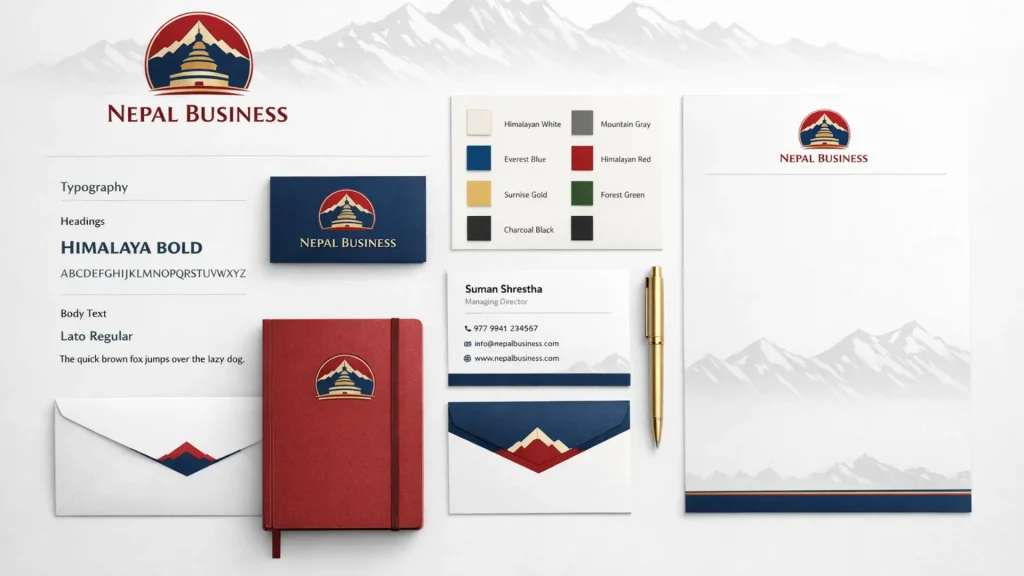
Most businesses in Nepal have a logo. Far fewer have a brand. And the difference between the two is the difference between being recognizable and being forgettable — between charging what you are worth and being forced to compete on price.
A brand identity is not just a logo and a color scheme. It is the complete system of visuals, language, and personality that makes your business immediately recognizable and emotionally resonant to your target customer. In Nepal’s growing and increasingly competitive market, a strong brand identity is one of the most valuable assets your business can build.
This guide walks you through every step of building one from scratch.
What Is Brand Identity — And What It Is Not
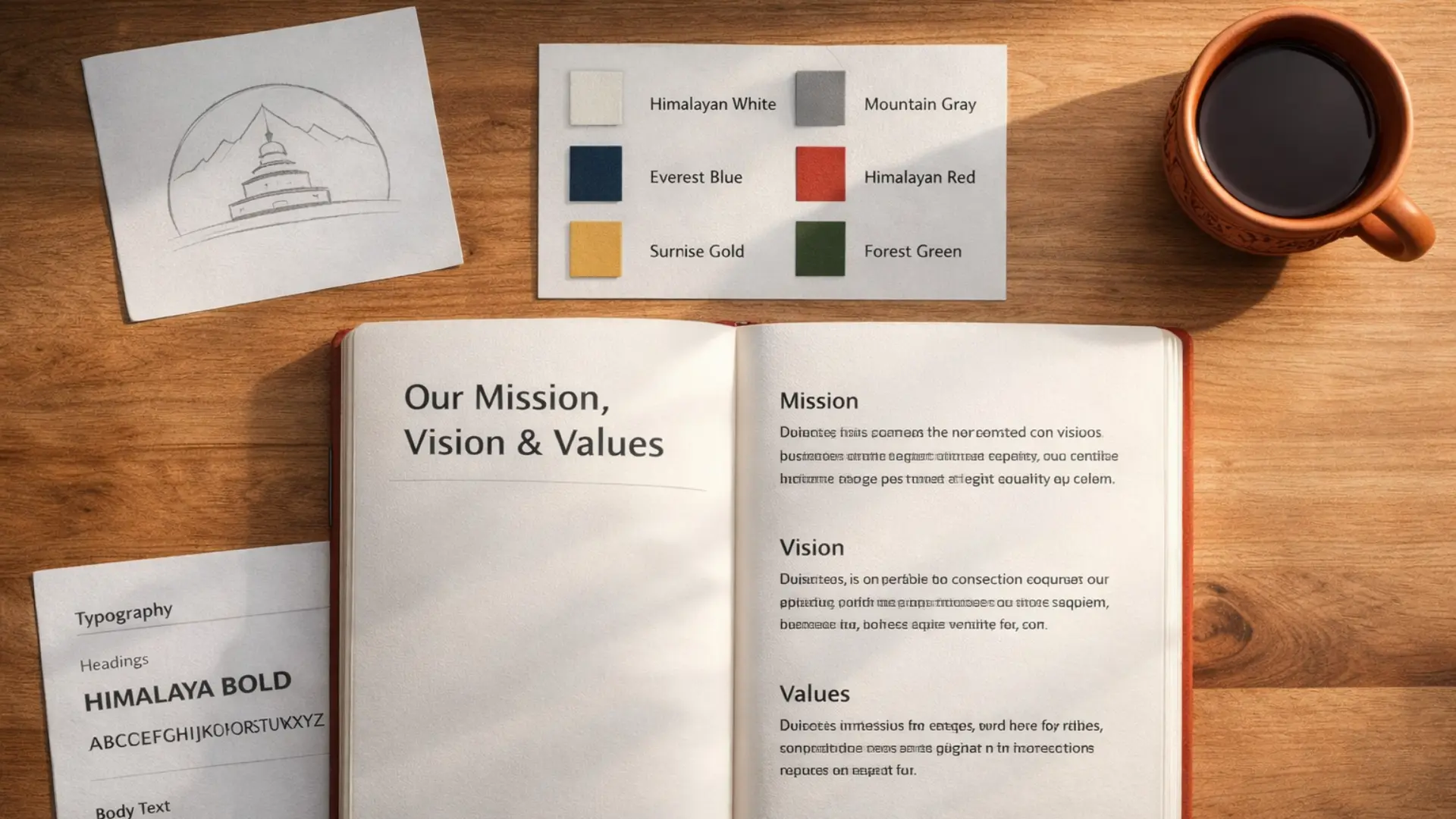
Brand identity is the collection of visual and verbal elements that represent your business consistently across every touchpoint. It includes: your logo, your color palette, your typography, your photography style, your tone of voice, and the overall feeling your communications create.
What brand identity is not: it is not your product or service, it is not your price, and it is not just your logo. A powerful brand identity could exist even if you changed your product — think of how Apple brand identity survived a complete overhaul of its product line multiple times.
In the Nepali market, where trust is built through consistent repeated exposure and word-of-mouth, a coherent brand identity accelerates trust-building significantly. Customers who see your brand consistently across Facebook, your website, your shop front, and your packaging develop confidence in your business before they ever interact with you directly.
Step 1 — Define Your Brand Foundation
Your Mission
Your mission is why your business exists beyond making money. It is the value you create for your customers and your community. For a Kathmandu bakery, it might be: “To bring the comfort of freshly baked goods to Nepali homes every morning.” Keep it short, specific, and genuine.
Your Values
Values are the principles that guide every business decision. Choose 3 to 5 that genuinely reflect how you operate — not aspirational words you wish applied to your business, but actual principles you act on every day. These values will guide your tone of voice, your hiring decisions, and how you handle difficult situations publicly.
Your Target Audience
Define your primary customer in specific detail. Not “everyone in Kathmandu” but “Kathmandu women aged 25 to 40 who care about quality food and are willing to pay a premium for it.” The more specific your audience definition, the more precisely you can design a brand that resonates with them.
Step 2 — Build Your Visual Identity
Logo Design
Your logo is the anchor of your entire visual identity. Invest in having it professionally designed. A good logo is: simple enough to be recognizable at any size (from a WhatsApp profile photo to a shop sign), distinctive enough to stand out from competitors, and relevant to your industry without being generic. Request all file formats: SVG for scalability, PNG on transparent background for digital use, and PDF for print.
Color Palette
Choose a primary color palette of 2 to 4 colors. Understand the cultural associations of colors in the Nepali context: red carries significance from the national flag and festivals; white has traditional associations; blue commonly signals trust and professionalism across cultures. Your palette should reflect your brand personality — a premium brand might use deep navy and gold; a fresh, natural brand might use greens and earthy neutrals. Specify exact HEX codes (for digital) and CMYK values (for print) so your colors are always reproduced correctly.
Typography
Select two typefaces: one for headings (usually bolder and more characterful) and one for body text (clean and highly readable). Use these consistently across every communication. Using three or more typefaces is a common mistake that creates visual chaos and undermines professionalism.
Step 3 — Develop Your Brand Voice
Your brand voice is how your business sounds in writing. It should be consistent whether you are writing a social media caption, a proposal, a WhatsApp reply, or an out-of-office email.
Define your voice with three to four adjectives and then describe what each means in practice. For example: Confident — we state our expertise without boasting. Warm — we address customers by name and write in conversational Nepali or English. Clear — no jargon, no complex sentences, always straightforward.
Create a short “sounds like / does not sound like” reference. When new team members join and need to write anything publicly, this guide ensures consistency even without supervision.
Step 4 — Apply Your Brand Consistently Across Every Touchpoint
A brand identity only works if it is applied consistently. Every customer interaction should feel like it comes from the same business: your Facebook cover photo, your Instagram bio, your business card, your email signature, your WhatsApp status, your shop signage, your delivery packaging, your invoices.
The easiest way to ensure consistency is to create a simple brand style guide — a one-to-two page document that shows your logo variations, your color codes, your fonts, and basic usage rules. Share this with anyone who creates content or materials for your business.
Step 5 — Build Brand Trust Over Time
The most important truth about branding is that recognition and trust are built through repetition. Consistency over time is more powerful than any single brilliant piece of branding. A business with a modest but consistent visual identity, applied reliably for 18 months, will be more recognizable and trusted than a business with an elaborate brand that is applied inconsistently.
Post with your brand voice every week. Use your brand colors on every graphic. Respond to every customer message in your brand voice. Over time, customers begin to recognize you instantly and associate your brand with the quality and reliability of your actual work.
Common Branding Mistakes Nepali Businesses Make
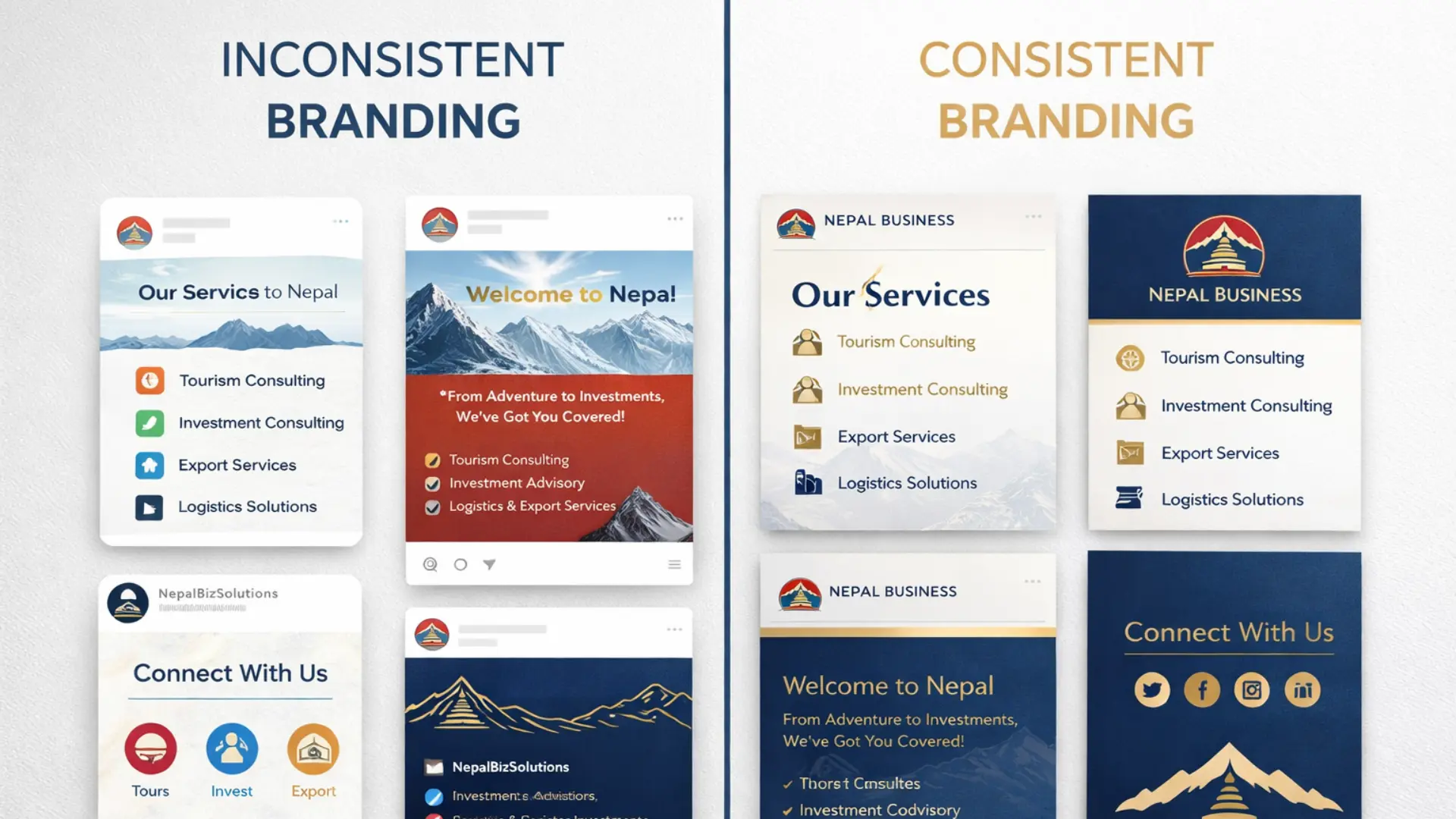
- Changing logo, colors or name too frequently — this resets all the brand recognition you have built
- Copying a competitor brand — this creates confusion and undermines your distinctiveness
- Using a different tone on different platforms — your Facebook voice should match your WhatsApp voice
- Neglecting the brand in operational touchpoints — invoices, packaging, and email signatures matter too
- Building a brand in isolation — involve a few trusted customers in the process to check that your intended identity matches how customers actually perceive you
How Tech Babal Builds Brands for Nepali Businesses
Our branding service covers everything from brand strategy and naming to full visual identity design including logo, color system, typography, brand guidelines, and all core collateral. We have helped businesses across Nepal build brands that they are proud of and that their customers remember.
See our branding packages at techbabal.com/services/branding.
Ready to grow your business with Branding & Rebranding?
Book a free 30-minute strategy session with Tech Babal. No sales pitch — just clarity.
Book Free Session → techbabal.com/contact
See pricing → techbabal.com/pricing