

Nepal’s digital landscape is changing fast. Businesses in Kathmandu that once relied on word-of-mouth or a single Facebook page are now getting left behind by competitors who show up everywhere their customers look — on Google, Instagram, YouTube, and even WhatsApp.
The solution is a full-funnel digital marketing strategy. Not just one channel, not just one campaign — but a coordinated system that guides your customer from first hearing about you all the way to buying from you and recommending you to others.
In this guide, we will walk you through exactly how to build one, step by step, with practical examples from the Nepali market.
What Is a Full-Funnel Digital Marketing Strategy?
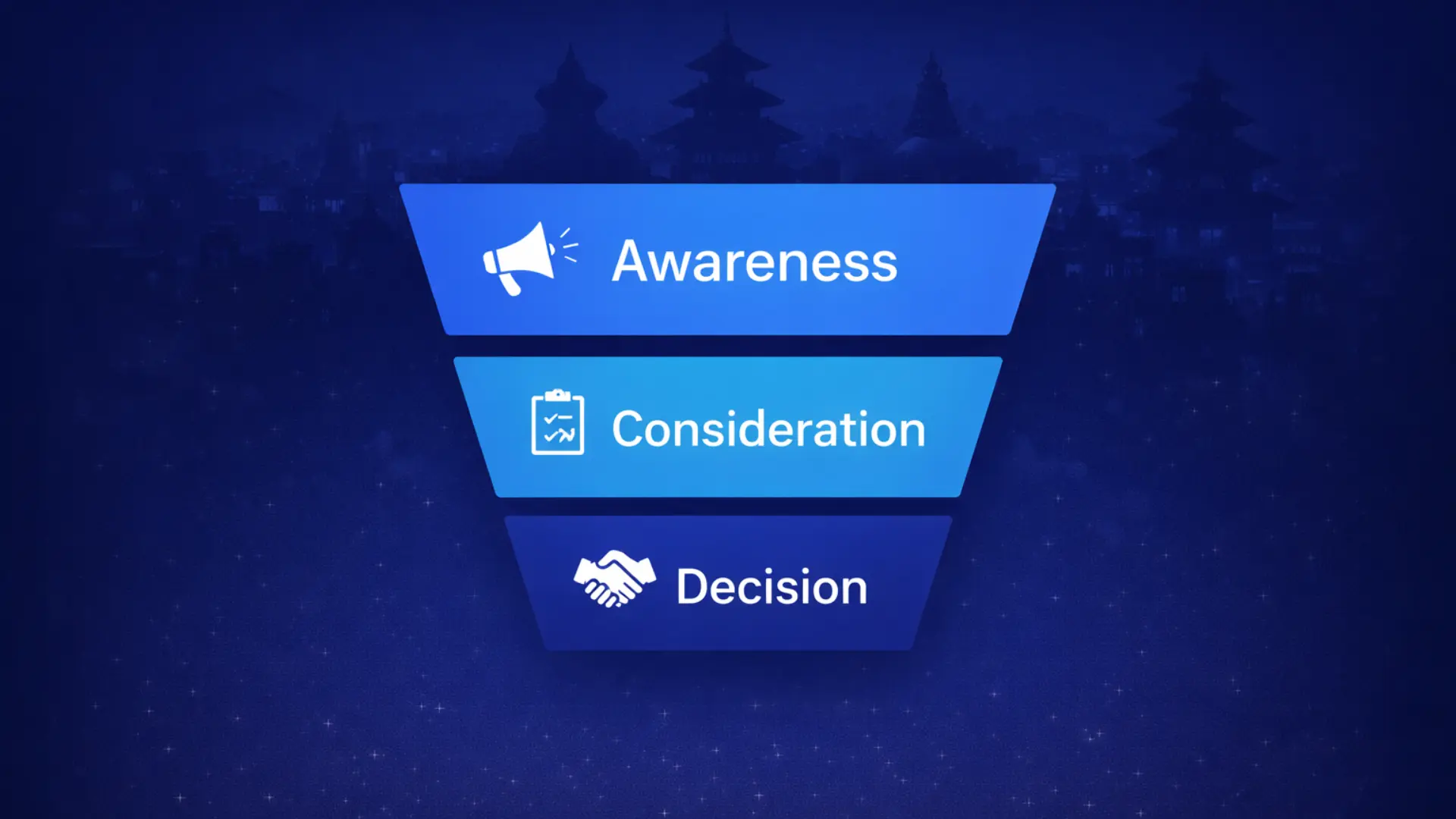
A full-funnel strategy means reaching your customer at every stage of their buying journey. The “funnel” is a simple model that describes how people move from strangers to customers.
It has three core stages:
- Top of Funnel (TOFU) — Awareness. The customer discovers your business for the first time. They might see your Instagram post, find your blog on Google, or notice your ad on Facebook.
- Middle of Funnel (MOFU) — Consideration. They know you exist. Now they are comparing you against competitors. They visit your website, read reviews, check your social media.
- Bottom of Funnel (BOFU) — Decision. They are ready to buy. Now they need one final push — a compelling offer, a clear call to action, or a trusted recommendation.
Most Nepali businesses only operate at one stage of this funnel. The businesses that grow consistently operate at all three simultaneously.
Why Most Kathmandu Businesses Use Only One Channel — And Why That Is a Problem

Walk into any digital marketing conversation in Nepal and you will hear the same thing: “We run Facebook ads” or “We post on Instagram every day.” These are not bad tactics — but they are incomplete.
Here is the reality: your customer does not live on one platform. Before calling you, a typical Kathmandu buyer might:
- Discover you via an Instagram Reel shared by a friend
- Google your business name to check if you are legitimate
- Visit your website — and leave because it loads slowly or looks outdated
- See your retargeting ad on Facebook and come back
- Read a Google review and finally decide to call
If you are missing from steps 2, 3 or 4 in that journey, you are handing those customers to a competitor who is not missing from any step. A full-funnel strategy closes every gap.
Step 1 — Know Your Customer and Where They Are Online
Before running a single ad or writing a single caption, you need a clear picture of who your customer is and where they spend time online. For most Kathmandu businesses, here is a useful starting framework:
- Age 18–28: Instagram, TikTok, YouTube Shorts
- Age 28–40 consumer: Facebook, Instagram, Google Search
- Age 35–55 business decision-maker: Facebook, LinkedIn, Google Search
- Local intent buyer (any age): Google Maps, Google Search
Build a simple one-page customer profile. Include: age range, location (which area of Kathmandu or which city), the problem they need solved, where they spend time online, and what would make them trust you enough to buy. Keep it practical and specific. “Everyone” is not a target audience.
Step 2 — Build Your Awareness Layer (Top of Funnel)
The top of your funnel is purely about being discovered by people who do not know you yet. Your goal here is not to sell. It is to be helpful, visible, and memorable.
SEO and Blog Content
Write blog posts that answer the questions your customers are already searching for on Google. For a restaurant in Thamel, that might be “best momos in Thamel” or “authentic Nepali food experience Kathmandu.” For a law firm, it might be “how to register a company in Nepal.” Useful content that ranks on Google builds trust before a customer ever visits your website directly.
Social Media Organic Content
Post consistently on the platforms where your audience lives — three to five times per week at minimum. Focus on Reels and short video content, which consistently gets the most organic reach on both Facebook and Instagram in Nepal right now. Show your team, your process, your results, and your customer stories.
Google Business Profile
For any Kathmandu-based business, your Google Business Profile is one of the most powerful free tools available. Keep your hours updated, add photos weekly, respond to every review, and post updates regularly. This is what makes you appear on Google Maps when someone searches “[your service] near me.”
Step 3 — Build Your Consideration Layer (Middle of Funnel)
Once someone is aware of you, your job is to give them compelling reasons to choose you over your competitors. This is where most Nepali businesses drop the ball — they have good awareness but a weak consideration layer.
A Website That Converts
Your website is your most important middle-funnel asset. It needs to load in under 3 seconds, clearly explain what you do, show proof (client logos, reviews, case studies), and make it easy to take the next step. A slow, unclear website loses you customers who were already interested.
Testimonials and Case Studies
Social proof is particularly powerful in the Nepali market where trust and word-of-mouth carry enormous weight. Display real testimonials with photos, names, and specific results. A case study showing “how we helped a Pokhara restaurant increase online orders by 60%” is worth more than any amount of polished copy.
Email and WhatsApp Follow-Up
Not every visitor will contact you on their first visit. Use email newsletters or WhatsApp broadcast lists to stay in touch with people who have shown interest — shared their details, messaged you, or visited your website. Consistent follow-up through trusted channels builds the relationship that eventually converts.
Step 4 — Build Your Decision Layer (Bottom of Funnel)
This is where you turn interested prospects into paying customers. It requires clarity, urgency, and the lowest possible friction between interest and purchase.
- Make your contact options obvious — phone number, WhatsApp, and inquiry form all visible on every page
- Use Google Search ads to capture high-intent searches like “SEO agency Kathmandu price” — these people are ready to buy
- Run Facebook and Instagram retargeting ads to people who visited your website but did not contact you
- Offer a clear, low-commitment entry point: a free consultation, a free audit, or a trial period
- Display your pricing transparently — Nepali customers distrust hidden pricing more than most
Step 5 — Measure, Report, and Optimise Every Month

A strategy without measurement is guesswork. Set up these three tools from day one and review them every month:
- Google Analytics 4: track traffic sources, pages visited, conversions, and user behaviour
- Meta Business Suite: monitor reach, engagement, ad performance and audience insights
- Google Search Console: see which keywords bring you traffic, your average position, and your click-through rate
Every month, identify your top-performing channel, your weakest channel, and one specific thing you will improve in the next 30 days. Small, consistent improvements compound into significant growth over 6 to 12 months.
How Tech Babal Builds 360° Strategies for Nepali Businesses
At Tech Babal, our 360° Digital Marketing service is built on this exact framework. We audit where you are, map out your customer journey, identify the gaps in your current marketing, and build a coordinated strategy that covers every stage of the funnel — SEO, social media, paid ads, content, and web presence — all working together under one unified plan.
We work with mid-size businesses across Nepal who want to stop guessing and start growing with a clear, measurable strategy. Learn more at techbabal.com/services/360-digital-marketing.
Ready to grow your business with 360° Digital Marketing?
Book a free 30-minute strategy session with Tech Babal. No sales pitch — just clarity.
Book Free Session → techbabal.com/contact
See pricing → techbabal.com/pricing