

When Nepalese businesses start taking digital marketing seriously, they face a strategic question: is it better to do one channel extremely well or spread effort across multiple channels (360 vs Single Channel)?
Both approaches have advocates. Both work in specific situations. Here’s the honest comparison.
The Case for Single-Channel
There’s a real argument for concentrating on one channel, particularly for very small businesses starting with digital marketing.
It’s simpler to manage—one platform, one set of metrics, one learning curve. Budget concentrates, which can produce faster results. Expertise develops rapidly when focus is narrow. For some business types—an Instagram-first lifestyle brand, for example—one channel may genuinely dominate.
The most successful single-channel approach in Nepal: businesses that dominate Facebook for their local area. A Kathmandu restaurant with 15,000 engaged followers, posting daily with strong community management, generates significant business from Facebook alone.
The Limitations

The problem with single-channel marketing isn’t what it does—it’s what it misses. Those missed customers represent real lost revenue.
You’re invisible to customers who find businesses via Google Search. You can’t retarget website visitors who showed buying intent but didn’t convert. Algorithm changes can cut your reach overnight. You have no fallback if your channel underperforms. You miss the compounding effect when channels reinforce each other.
Why 360 Delivers Higher ROI
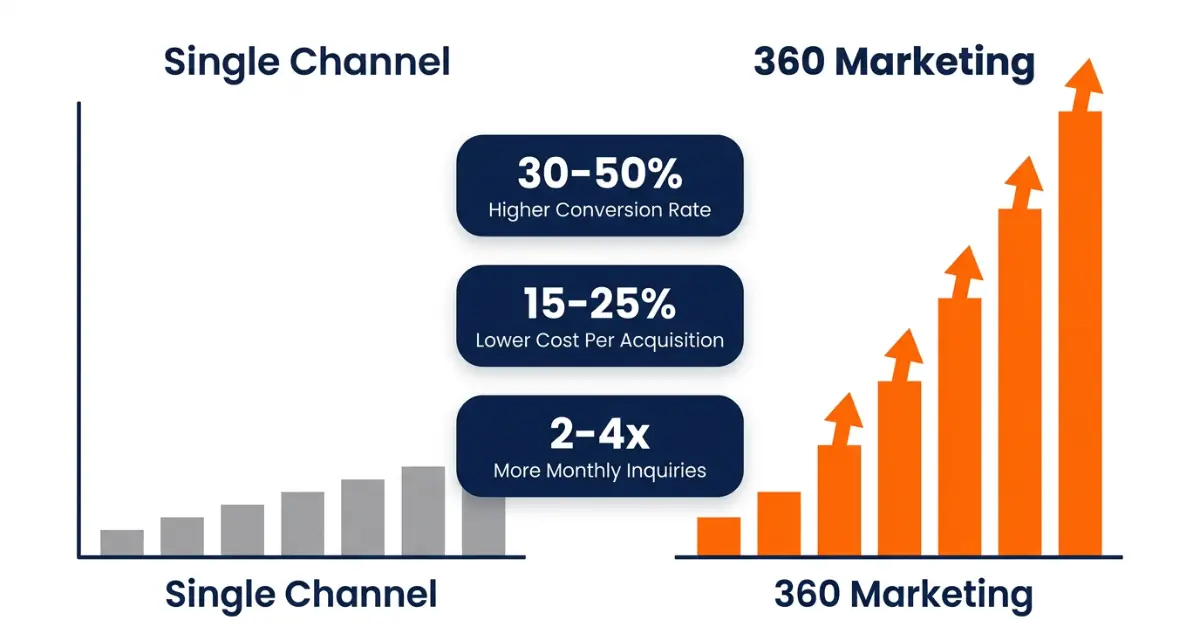
Here’s the key insight: individual channels deliver linear returns. Combined channels deliver compounding returns.
When SEO, social media, and paid ads point to the same optimized website, each channel multiplies the others’ effectiveness. A customer who sees your Instagram post and then finds you at the top of Google converts at a significantly higher rate than someone who found you via one channel alone.
Based on our client work, coordinated 360 strategies typically deliver 30-50% higher website conversion rates compared to single-channel traffic, 15-25% lower cost-per-acquisition from paid ads when supported by SEO, and 2-4× more monthly inquiries at similar budget levels.
When Single-Channel Makes Sense
Your business is brand new with a very limited budget—start with the channel most likely to generate immediate returns. You’re testing a new market or product—single-channel experiments cost less and move faster. Your target audience is overwhelmingly on one platform—B2B businesses where every client uses LinkedIn, for example.
The Smart Approach
Most Nepal businesses shouldn’t choose permanently between approaches. Start with one or two channels most likely to generate early results—usually Facebook plus Google Business Profile for local businesses. Use those wins to fund expansion over 6-12 months.
A business that builds genuine strength across SEO, social, and website optimization over 12 months will, by month 13, generate more organic inquiries than it can handle—often outperforming competitors with 3× the budget but scattered, disconnected approaches.
Ready for 360 Digital Marketing?
We assess your channels, budget, competition, and goals—then recommend what delivers the best ROI for your Nepal business. Visit: techbabal.com/services/digital-marketing